Agent-native reporting framework
Give an agent the same task twice and you get two differently shaped reports. This framework makes the shape a contract.
Scenario-routed report protocols, bounded context bundles, checkpointed long-task memory, and mechanical structure audits — installable into Claude Code, Codex, Cursor, and GitHub Copilot, or usable by any agent that can read one Markdown index. Everything on this page links to a committed artifact you can re-check.
302tests passing in CI
16 / 16strict audits · final round
16 / 16semantic oracles · final round
7 / 7deck pages, human-reviewed render
0runtime dependencies (stdlib only)
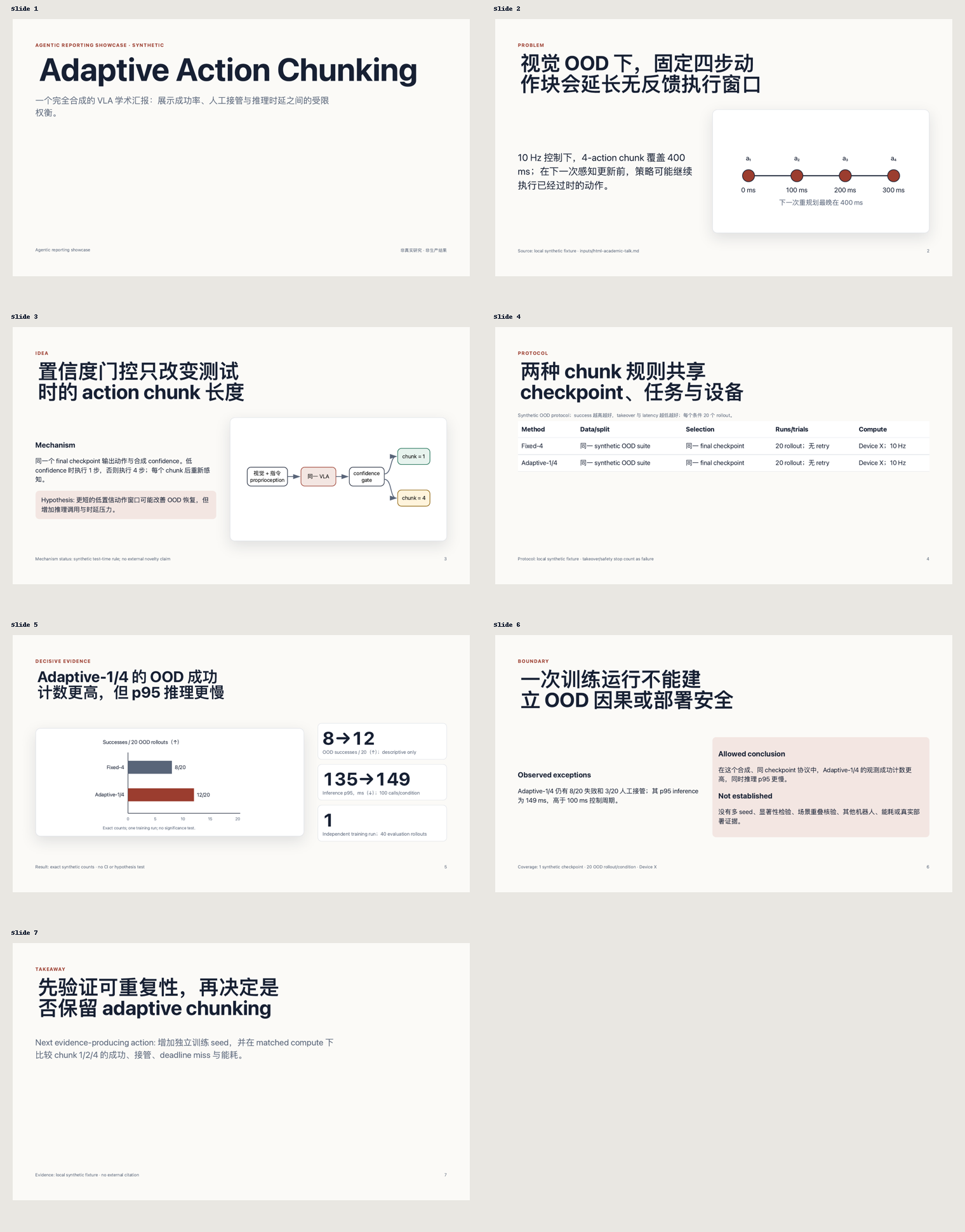
A real output: 7-page assertion–evidence academic deck built with the
academic-talk-html template, printed through real Chrome, with every
audit receipt kept in the repository. Facts on the slides are synthetic fixtures.
The honest before/after: a real strict-audit repair trajectory
Most demo pages show only the final polished output. This one shows the
failure log too. When the 12 core-mode showcase reports were first drafted,
the checkpoint-bound audit --strict passed 1 of 12. Three repair
rounds later, all 12 passed — without adding a single fact beyond the evidence
bundle and without loosening strict mode. Click through the rounds; every
finding below is quoted from the committed failure log.
Repair principle, quoted from the log: “补充真实存在的语义标签与表格说明,合并过度标题;
不添加证据包以外的事实,不降低 strict。” The audit forces the report to surface
what is already true — it never invents content to pass.
Also in the same log: the semantic oracle itself started at 6/16 because its forbidden-substring check flagged explicit negations ("cannot claim significance") as violations. The fix went into the oracle (negation-aware matching), never into the reports — facts were not rewritten to appease a broken check. Full trail: first-failures.md · audit-summary.md
How one report is produced
The same seven steps ran for all 16 showcase reports and the deck. The audit in step 6 reads the same on-disk checkpoint written in step 3, so the contract survives context compaction in long tasks.
1Freeze tasktask text is fixed before routing
2Routedeterministic mode + profile choice
3Checkpointcontract written to disk
4Bounded bundleprotocol context under an explicit char budget
5Writeagent drafts against the bundle
6Strict auditsame-checkpoint structural check
7ReceiptsJSON receipts committed with the report
16 finished reports you can read right now
Twelve primary modes and four research profiles, each a complete report with its own audit receipt. Pick one — the opening line below is quoted verbatim from the committed file. Note how every opening leads with the outcome and its boundary.
Numbers, each with a receipt
No number on this page is asserted from memory. Every cell links to the file or workflow that produced it.
302tests passing (unit + study-host + render regression)
CI runs →
16 / 16Markdown checkpoint strict audits, final round
audits/*.json →
16 / 16report-specific semantic oracles, final round
oracles/ →
9 / 9HTML static & self-containment checks on the deck
static-validation.json →
11 / 11PDF/DOM/text/PNG real-render checks (Chrome + Poppler)
validation.json →
7 / 7deck pages passing human per-page visual review
manual-visual-check.md →
12 + 5 + 4primary modes + display modules + research profiles
CATALOG.md →
0runtime dependencies —
reportctl is Python stdlib only
reportctl.py →Where it sits among the alternatives
This is a mechanism comparison, not a measured-outcome claim — the project deliberately refuses to assert quality gains it has not measured. Each row is a property you can verify from the code.
| Mechanism | Bare prompting | Style guide in system prompt | One big report template | This framework |
|---|---|---|---|---|
| Per-scenario report structure (short answers stay short) | — | — | — | ✓ 12 routed modes |
| Hard bound on protocol context loaded per task | ✓ trivially | ◐ always all of it | ◐ always all of it | ✓ explicit char budget |
| Contract survives context compaction in long tasks | — | ◐ if prompt is resident | — | ✓ on-disk checkpoint |
| Mechanical structure audit before delivery | — | — | — | ✓ audit --strict |
| Committed receipts for every claim of compliance | — | — | — | ✓ JSON per report |
| Checks facts are true | — | — | — | — honestly, no |
The last row is intentional: the audit verifies structure and evidence discipline, never truth. A framework that claimed otherwise would be overclaiming — which is exactly what its protocols forbid.
Pages from the live deck
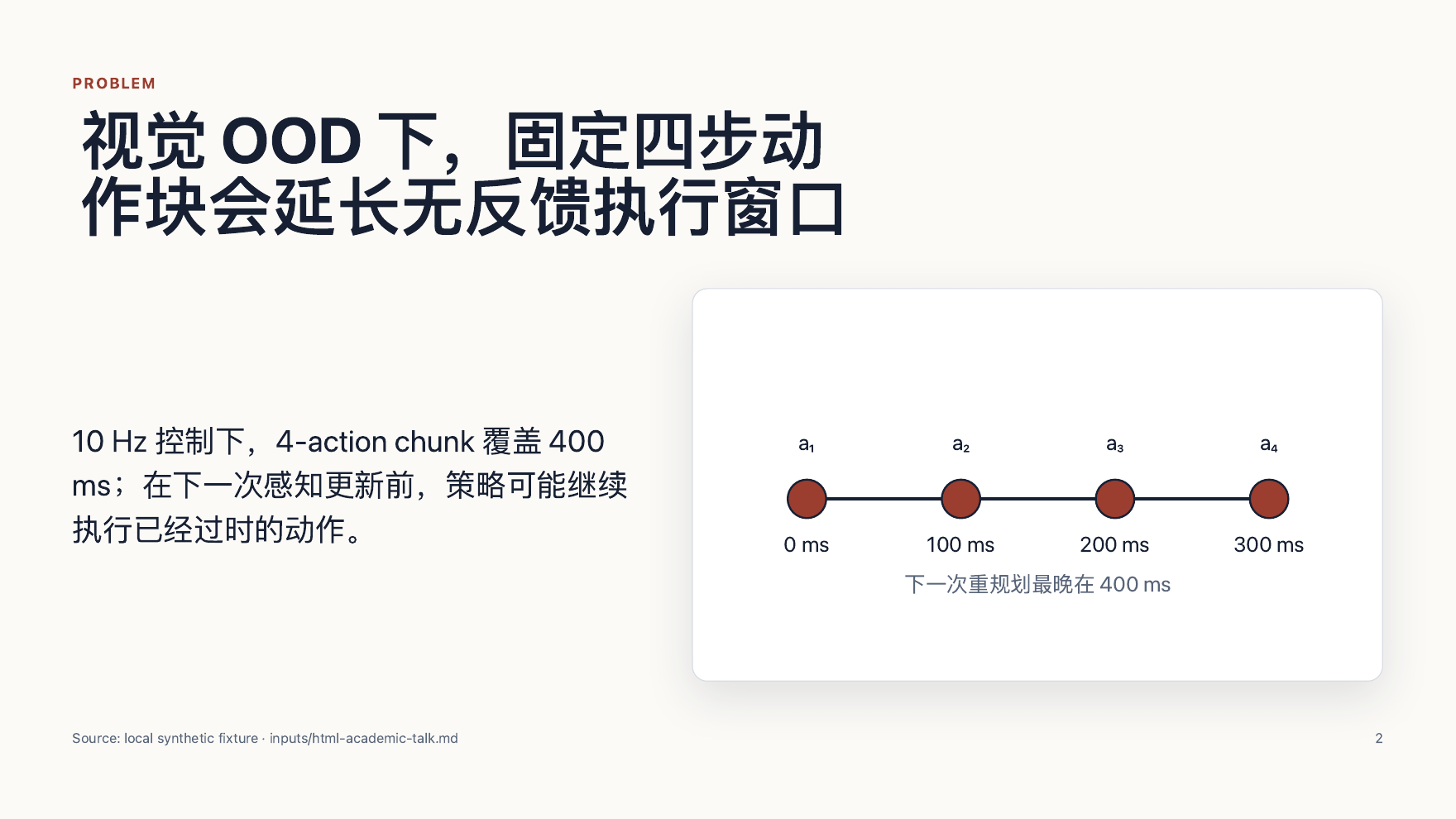
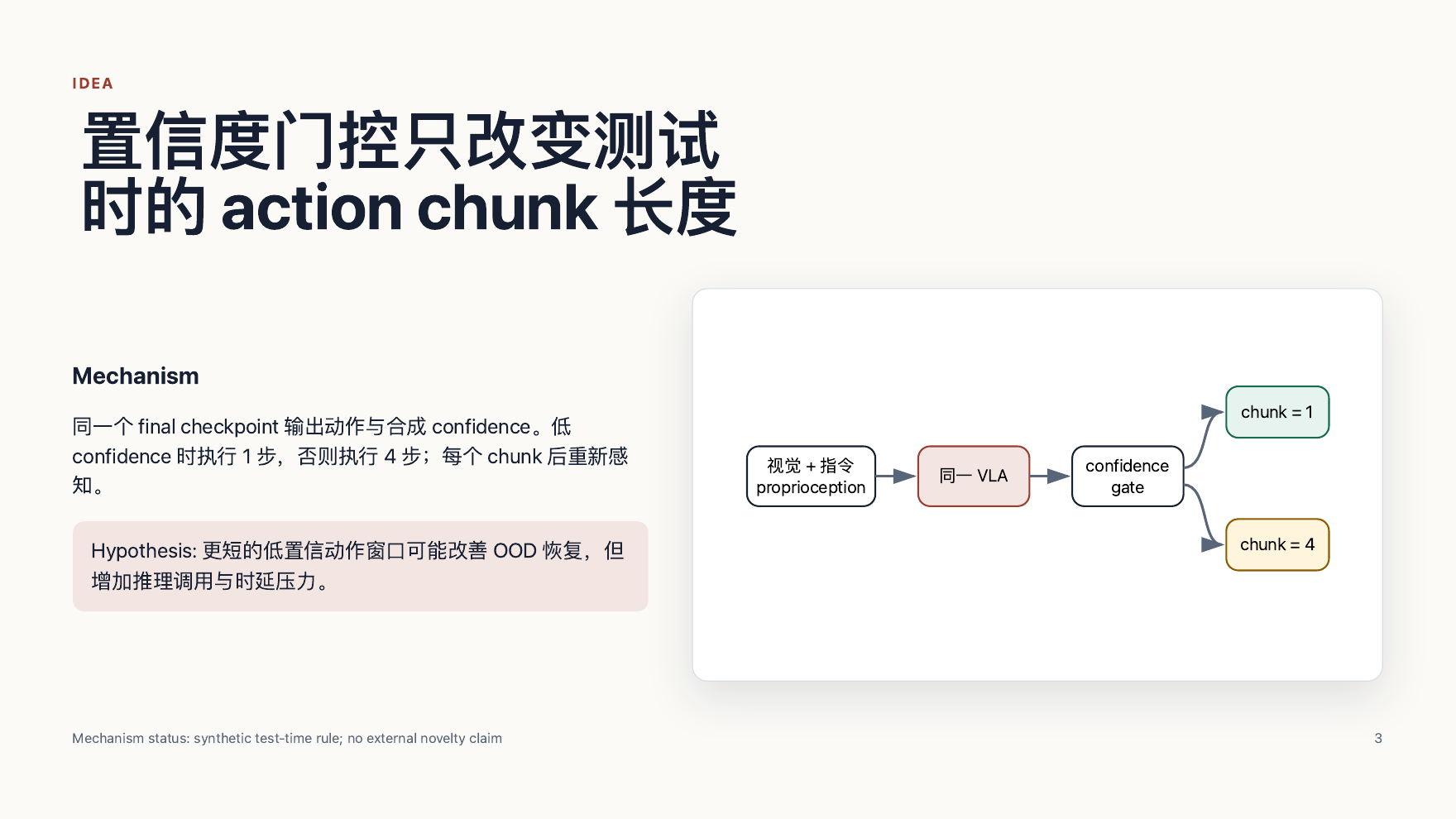
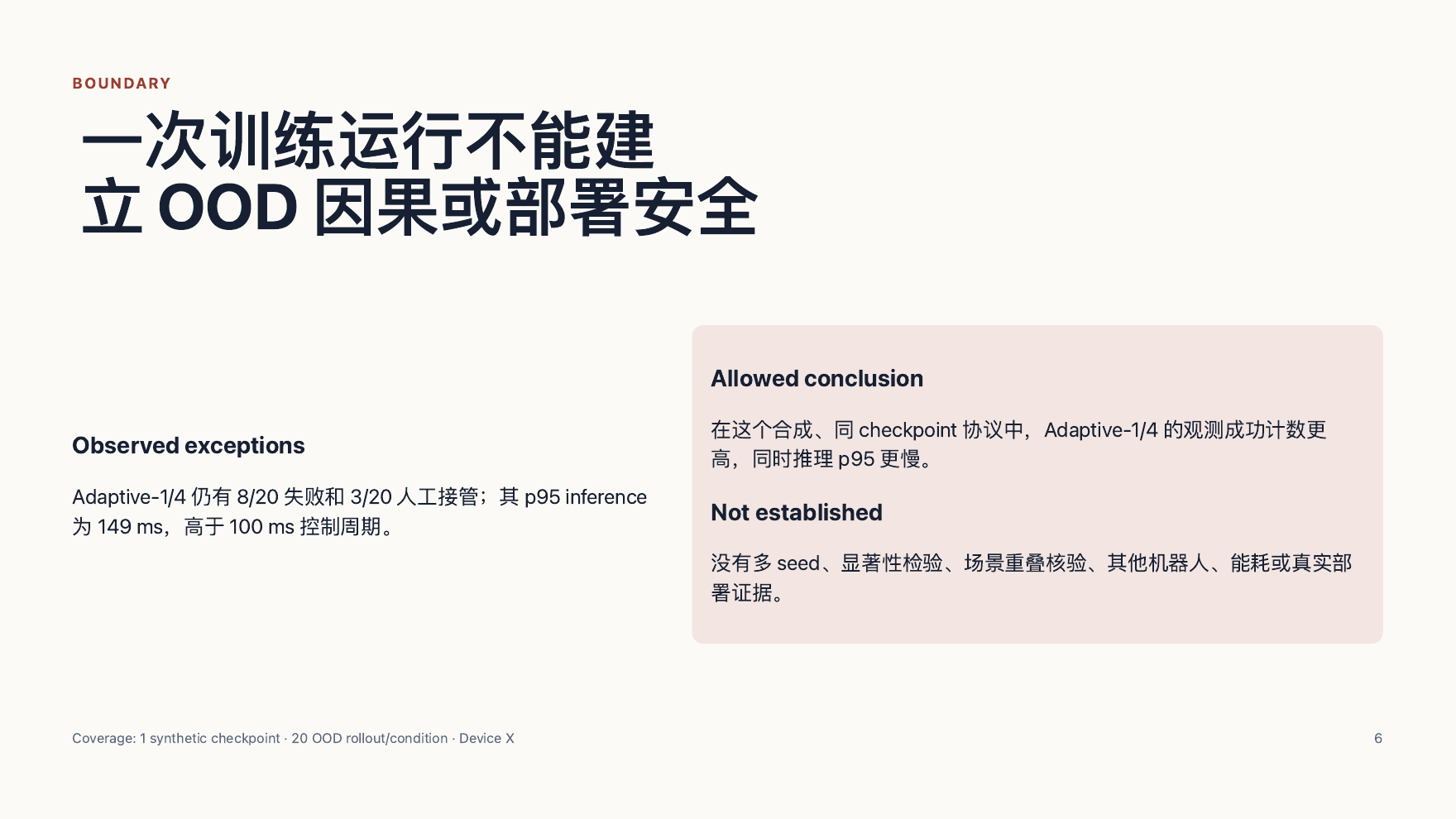
Every page above is a Chrome-printed render of the same HTML deck — dependency-free, responsive, keyboard-navigable, printable at 16:9.
Two ways to start
Fastest: link-only trial (no install)
Paste this into any agent that can fetch a URL. It reads one bounded index, routes your task, and reports — nothing is written to your project.
请先读取该仓库的 AGENT_START.md,
并用其中的最小路由完成本次最终汇报;
不要读取全部协议。仓库:
https://github.com/asimfish/super_agent_presentation
Full: install as a skill
Installs the protocol tree and reportctl into your project for
Claude Code, Codex, Cursor, or GitHub Copilot. Dry-run first, apply when happy.
git clone https://github.com/asimfish/super_agent_presentation.git
cd super_agent_presentation
python3 scripts/install.py apply \
  --target /path/to/your/project --host codex
Materials
Live demo deck (HTML)7 pages, self-contained, keyboard-navigable
The same deck as PDF824 KB, printed through real Chrome
All 16 example reportswith routing, audit, and oracle receipts
The failure logevery first attempt that failed, and why
Protocol catalogall modes, modules, profiles, templates
中文文档完整中文 README 与使用说明
Evidence boundary. All reports and deck facts shown here are synthetic fixtures — they demonstrate report shape, not real research results. This framework does not claim measured quality gains it has not measured. What is verified — deterministic routing, bounded bundles, checkpoint and audit mechanics, real-render regression — is listed above with receipts, and every number on this page can be re-derived from the repository.